Large Group Coach Hire in London: 72 Seat Coach or Double Decker?
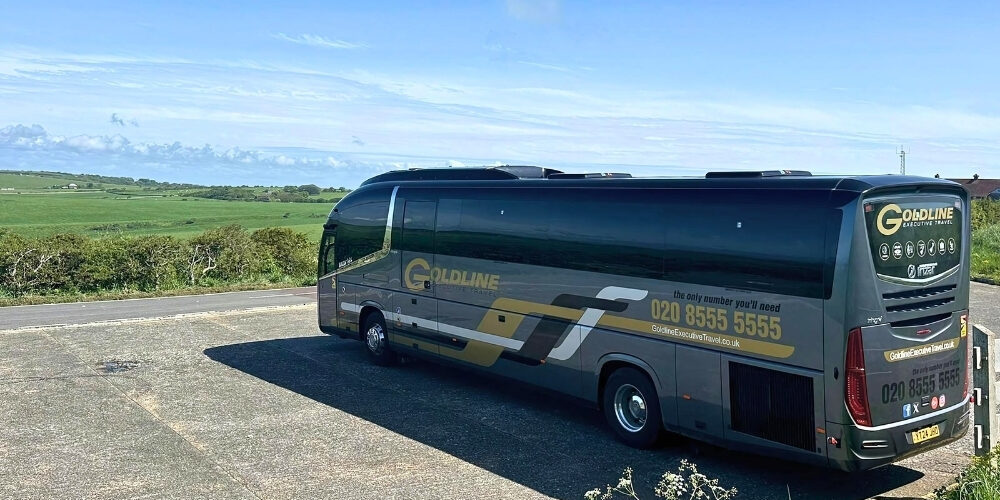
For groups of 50 to 72 people travelling from London, a modern single deck 72 seat coach usually beats a double decker on practicality, not just price. It clears almost every UK bridge and venue entrance a double decker cannot, keeps the whole group on one level with one door, and covers group sizes most searchers actually have. Goldline Executive Travel’s 72 seat Mercedes Benz coach is the largest vehicle in the fleet and the sensible ceiling for London group travel.
- Goldline’s 72 seat coach is the largest vehicle in the fleet, with 50 cases of luggage space and departure always from London.
- A typical double decker coach stands 4.0 to 4.3 metres tall, against a UK standard road clearance target of 16 feet 6 inches, around 5.03 metres.
- Single deck coaches, including Goldline’s 72 seater, typically run 3.5 to 3.9 metres tall, clearing the low bridges and venue gateways that catch double deckers out.
- The London Congestion Charge is £18 a day per vehicle, not per passenger, so one 72 seat coach carrying 70 people works out at roughly 26p a head for the charge alone.
- Splitting a 65 person group across two smaller coaches means two drivers, two Congestion Charge payments and two coach parking spaces, costs that do not halve just because the group did.
What Counts as Large Group Coach Hire in London?
Large group coach hire in London generally means transport for 50 people upward, the point at which minibuses stop making sense and a full size coach becomes the only vehicle that keeps everyone together. Goldline Executive Travel’s coach range covers this bracket with 33, 49, 57 and 72 seat coaches, all departing from London and covering destinations across England, Scotland, Wales and Europe.
Searchers typing “double decker coach hire London” are usually chasing maximum capacity for one booking, not a double decker specifically. That distinction matters, because the two things are not the same request, and treating them as identical is where most coach hire pages on this topic go wrong.
Large Group Coach Hire London: Is a Double Decker or a 72 Seat Coach Better?
A double decker coach typically seats 70 to 90 passengers across two levels and stands 4.0 to 4.3 metres tall. Goldline’s 72 seat single deck coach carries almost the same number of people, in a vehicle roughly half a metre lower, with a single boarding point and no upstairs seating to manage. For the vast majority of London group bookings in the 50 to 72 passenger range, the single deck coach delivers the same practical outcome with less risk.
Most coach hire sites that sell double deckers do not mention height at all. One that does, comparing double and single deck coaches, states plainly that “some routes have low bridges, narrow country lanes, or venues with restricted height access that a double decker simply cannot use”, but stops short of giving any actual figures. That gap, real height numbers set against real UK clearance standards, is exactly what this page fills.
The trade for that extra half metre of height is usually 10 to 20 extra seats. For a group that has genuinely confirmed 75 or more passengers, a double decker is the only way to fit everyone in one vehicle and Goldline can advise on specialist double decker operators for that specific case. For everyone booking in the much more common 50 to 72 range, the height risk buys nothing, because a single deck coach already covers the numbers.
How Double Decker Coach Height Actually Restricts Large Group Travel in London
This is the section most competitor pages skip entirely. Here is the actual arithmetic.
UK government guidance on low bridge signage sets the standard road clearance target at 16 feet 6 inches, approximately 5.03 metres. Bridges lower than that are normally signed as low bridges, and anything close to that figure is where a tall vehicle starts running into trouble on ordinary A roads, not just obscure rural lanes.
A double decker coach at 4.0 to 4.3 metres tall has only 0.7 to 1.0 metres of clearance under that national standard. That sounds like a comfortable margin until you look at where large groups actually travel. Historic town centres, rural approach roads and older venue gateways frequently sit well below the national standard, with clearances reported as low as 3.8 to 4.2 metres in these settings. A double decker at the tall end of its height range, 4.3 metres, is taller than some of those clearances. It cannot travel that road at all, full stop, regardless of how good the driver is.
Goldline’s single deck coaches, including the 72 seater, sit in the 3.5 to 3.9 metre range typical of modern single deck coaches. That clears the national 5.03 metre standard by well over a metre, and clears almost all of the tighter historic and rural clearances that catch double deckers out. The practical result: a 72 seat single deck coach can reach venues, hotel driveways, school approach roads and historic town centres that a double decker of the same passenger count physically cannot enter.
None of this is a reason to avoid double deckers altogether. It is a reason to check the actual route and venue entrance before booking one, and to recognise that for most London group bookings under 75 people, the single deck coach removes the question entirely rather than answering it carefully every time.
Goldline’s 72 Seat Coach: Specifications and What They Mean for Your Group
Spec sheets list numbers. What matters is what those numbers mean for a group standing on a pavement in London trying to get somewhere together. The table below covers Goldline’s four large coach tiers with the derived detail that actually affects a booking decision.
| Coach size | Seats | Luggage (large cases) | Cases per seat | What it means for your group |
|---|---|---|---|---|
| 33 Seat Coach | 33 | 28 | 0.85 | Comfortable for a mid size wedding party or a small school group, with luggage room for an overnight stay. |
| 49 Seat Coach | 49 | 40 | 0.82 | The workhorse tier for corporate away days and school trips, still with a full suitcase per person plus hand luggage. |
| 57 Seat Coach | 57 | 50 | 0.88 | The best luggage ratio in the large coach range, the one to pick over the 72 seater for a multi day tour with heavy cases. |
| 72 Seat Coach | 72 | 50 | 0.69 | The largest vehicle Goldline operates, Mercedes Benz built. Maximum headcount in one booking, but the lowest luggage per passenger in the range. |
That last column is the derived fact nobody else in this market publishes. The 57 seat and 72 seat coaches both carry 50 cases, because luggage bay space is roughly fixed once a coach reaches a certain length, not because it scales with seat count. Divide it out and the 72 seater gives 0.69 cases per passenger against 0.88 for the 57 seater, a 27% drop in luggage allowance per head between the two tiers. For a day trip or a stadium run, nobody notices. For a three night UK tour where every passenger has a full suitcase, that gap is the difference between a smooth boarding and a luggage bay that will not close.
Every Goldline coach in this range carries the same core fit out: executive leather seating, climate controlled air conditioning, USB charging points, privacy tinted windows and professional, experienced drivers. The 72 seater and other larger coaches add onboard WC facilities, and wheelchair accessible options with passenger lift access are available across the fleet where a group has mixed mobility needs. Full specification for every size sits on the Goldline fleet page.
Which Goldline Vehicle Fits Your Group Size? Large Group Coach Hire Matrix
Coach hire is not one size fits all, and a group of 20 in a 72 seat coach is as much of a mismatch as a group of 70 trying to fit in a minibus. The matrix below maps Goldline’s full range against group size so you can see where your headcount actually lands, not just where the sales page wants to sell you.
| Group size | Best fit vehicle | Why | Wrong fit for |
|---|---|---|---|
| 1 to 8 | Standard MPV or 8 Seat Transporter | Right sized for a small executive group, full luggage capacity per person. | Anyone over 8, they will not fit. |
| 9 to 22 | 16, 19 or 22 Seat Minibus | Covers the classic small group booking, most stay in one vehicle without splitting. | Groups pushing toward 30, where per head cost starts favouring a coach. |
| 23 to 33 | 33 Seat Coach | The step up point where a coach starts beating two minibuses on cost and coordination. | Groups near 40 to 50, this size gets tight fast if numbers grow. |
| 34 to 49 | 49 Seat Coach | Standard mid size coach tier, strong luggage allowance, suits corporate and school groups. | Confirmed groups of 55 plus, book the next tier up before it sells out. |
| 50 to 57 | 57 Seat Coach | Best cases per seat ratio in the large coach range, ideal for multi day tours. | Groups needing every extra seat they can get on a fixed headcount. |
| 58 to 72 | 72 Seat Coach | The largest single vehicle Goldline operates, maximum headcount without splitting the group. | Multi day trips with heavy luggage, where the 57 seater’s ratio suits better. |
| 73 and above | Two coaches, or a specialist double decker operator | Genuinely beyond one vehicle’s capacity, worth a straight conversation about the honest options. | Anyone who has not yet confirmed a firm final headcount. |
The full coach hire range sits alongside the smaller minibus tiers on the Goldline site, and the quote request form is the fastest way to confirm which tier actually fits once you have a real number.
72 Seat Coach vs 57 Seat and 49 Seat Coach: Cost Per Head for Large Groups
Coach hire pricing depends on date, mileage, pickup time and driver hours, so any specific figure quoted online without those details is a guess. What can be shown honestly is how cost per head moves as group size and vehicle size scale together, using published UK day rate ranges for this class of vehicle as a guide.
Market day rates for a standard 49 to 57 seat coach in London and the South East typically sit in the £450 to £900 range for a full day, while larger and double decker class coaches in the same region run higher, often £700 to £1,500 depending on spec and demand. Hold the day rate roughly flat across the 49, 57 and 72 seat tiers, since driver cost and base vehicle cost do not scale sharply with seat count, and the cost per head arithmetic looks like this: a fixed day rate divided across 49 passengers costs noticeably more per head than the same rate divided across 72. Filling the largest coach you actually need, rather than booking a bigger one “just in case” and running it half empty, is where the real saving sits.
That is the honest version of the “bigger coach is cheaper per head” claim other pages make about double deckers. It is true, but it is just as true of a 72 seat single deck coach against a 49 seater, without needing the extra height risk to get there. The saving comes from filling more seats per vehicle, not from the vehicle having an upstairs.
Congestion charging changes the arithmetic further. TfL charges the London Congestion Charge at £18 a day per vehicle, not per passenger, between 07:00 and 18:00 on weekdays and 12:00 to 18:00 on weekends and bank holidays. One 72 seat coach carrying 70 people into central London pays that charge once, working out at roughly 26p a head. Splitting the same group across two 33 seat coaches means paying it twice, and across four minibuses means paying it four times, purely because more vehicles crossed the boundary, not because more people did. Coaches over 5 tonnes also fall under the separate London Low Emission Zone, which charges £100 a day for a non compliant heavy vehicle, a different scheme and a different threshold from the Congestion Charge that some competitor pages conflate. Confirming a coach’s emissions compliance before booking avoids that surcharge landing on the invoice.
Large Group Coach Hire for Corporate Away Days, Weddings, School Trips and Sporting Events
Numbers on a spec sheet mean little without a real journey attached to them. These are the situations where the 72 seat coach question actually comes up, all with pickup from London.
Corporate Away Day Coach Hire for 60+ London Staff
A London head office sending 65 staff to a countryside hotel outside the M25 for an annual conference is a textbook 72 seat coach booking. Many country house venues used for corporate events have narrow, tree lined driveways and older stone gateways built for horse drawn carriages, not double decker coaches. A single deck coach at 3.5 to 3.9 metres clears these approaches comfortably. Booking a double decker for the same headcount risks the coach being turned away at the gate and the whole group walking the last stretch, which is not the impression a corporate events team wants to make. See the full corporate travel service for how this is usually arranged.
School Trip Coach Hire for Large Groups Travelling from London
A London sixth form taking 68 students and staff to Windsor for the day sits right at the top of the large group bracket. Windsor’s own visitor guidance does not allow coach drop off directly at the castle gate; coaches use timed, pay and display bays on Alma Road and relocate afterward. The approach roads around Windsor’s older streets are exactly the kind of setting where a double decker’s extra height becomes a real constraint rather than a theoretical one. A 72 seat single deck coach handles the numbers and the access without the same risk. School group logistics, ratios and safeguarding are covered on the school transport page.
Wedding Guest Coach Hire for Large Groups from London
A wedding moving 55 London based guests to a country estate venue for the day faces the identical driveway and gateway problem as the corporate away day scenario above, often with the added pressure of a fixed ceremony start time that leaves no room for a coach getting turned back and rerouted. The wedding transport service is built around keeping a large guest list together and on schedule, which starts with picking a vehicle that can actually reach the venue.
Sporting Event and Match Day Coach Hire for Large Groups from London
A supporters’ group of 70 travelling from London to an away fixture needs a coach that fits the away stadium’s own coach parking arrangement, which is frequently run by a separate operator from the stadium itself, pre booked, and sited on an approach road with its own signed clearance. Checking that clearance against the coach booked, rather than assuming any coach fits any stadium car park, avoids a matchday scramble. The sporting events travel page covers race days, cup finals and away day logistics for groups this size, and the same access logic applies equally to festival and exhibition coach parks.
Who Large Group Coach Hire Isn’t For
A 72 seat coach is not the right answer for every group that thinks it needs one.
Groups under 30 people lose money on a large coach. Cost per head only improves with scale if the seats are filled; a 22 seat minibus carrying 20 people costs less overall and per head than a 72 seat coach carrying the same 20, and Goldline’s group travel minibus range covers this bracket properly.
Groups heading to a venue with multi storey car park access only should not book any large coach, single or double deck. Typical multi storey barrier heights run 2.0 to 2.5 metres, well below any coach on the road. This is a drop off and separate parking question, not a vehicle size question, and it applies equally whichever tier is booked.
Groups on a strict per seat budget who do not need to travel together may genuinely be better served by scheduled coach services or rail, covered in the alternatives section below, rather than paying for a private vehicle none of the group actually needs exclusive use of.
Groups heading to a venue with a confirmed, hard low bridge or single track approach that even a single deck coach cannot clear exist, rarely, but they exist. If a venue’s own access information states a height restriction under 3.5 metres, that rules out every coach in this article, and the honest answer is a minibus convoy or self drive cars for that specific leg.
One 72 Seat Coach or Two Smaller Coaches? The Real Cost of Splitting a Large Group
Splitting a large group across two vehicles feels like it should roughly halve the cost. It does not, because several costs are fixed per vehicle rather than per passenger.
Take a 65 person group choosing between one 72 seat coach and two 33 seat coaches. The two smaller coaches need two drivers instead of one, which is two sets of driver hours to plan around rather than one. They pay the £18 Congestion Charge twice rather than once if the route runs through central London. They need two coach parking bookings at the destination rather than one, which matters at venues charging a flat per coach parking fee regardless of size. And the group itself splits for the whole day, arriving and departing in two batches rather than moving as one, which for a wedding, a conference or a school trip is often the exact opposite of what the booking was meant to achieve.
None of that means splitting a group is always wrong. A genuinely confirmed group of 90, well beyond even the 72 seat coach’s capacity, has no honest single vehicle option and two coaches, or one large coach plus a minibus for the overflow, is the correct call. The point is that splitting should be a decision made because the numbers require it, not a default reached because nobody checked whether one larger coach would have covered the whole group for less.
Alternatives to Large Group Coach Hire in London: Minibuses, Trains and National Express
A single large coach is not the only way to move a big group, and an honest comparison names the real alternatives rather than pretending coach hire is the only option on the table.
Multiple smaller minibuses. For a group of 40 or fewer, two or three of Goldline’s 16 to 22 seat minibuses can work out competitively against one coach, particularly for short local journeys where the group is happy to arrive in stages. Past 50 people this stops making financial sense for the fixed cost reasons set out above.
National Express and scheduled coach services. For a very large, budget conscious group where travelling together is not essential, individually booked seats on a scheduled operator can be the cheapest per head option. The trade off is real: no private pickup point, no guarantee the group sits together, fixed departure times that will not wait for stragglers, and no return journey flexibility if the event runs long.
Train group tickets. National Rail’s GroupSave discount saves around a third off standard off peak fares for groups of 3 to 9 adults, but it caps out above 9 people and offers no equivalent discount structure for a 50 or 70 person group, so it simply does not scale to large group bookings. It remains a genuinely good option for smaller sub groups splitting off from a larger event.
Self drive minibus hire. Worth naming because it is commonly suggested and rarely actually available at this scale. Self drive minibus hire in the UK generally requires category D1 driving licence entitlement, and most car licences issued after 1 January 1997 do not include D1 automatically. D1 also tops out around 16 seats. Driving a 49, 57 or 72 seat vehicle requires a full category D PCV licence, which almost nobody in a typical group holds. Self drive genuinely is not an option once a group passes minibus scale, which most articles suggesting it as a large group alternative do not make clear.
Mistakes People Make Booking Large Group Coach Hire in London
Four mistakes come up repeatedly with large group bookings, and all of them are avoidable with the right question asked early.
Booking for the initial headcount, not the final one. A group that starts a booking process at 48 confirmed and grows to 55 by the RSVP deadline can find their 49 seat coach is now too small, and that the 57 or 72 seat tier is already booked for that date. Booking against a realistic maximum, with a smaller coach as a fallback if numbers fall short, avoids a late scramble.
Splitting a group across two vehicles by default. As covered above, this often costs more overall than one larger coach and always splits the group for the day. Check the single coach option first.
Not checking the venue’s own coach access before booking a double decker. A double decker booked without confirming the venue’s gate height, driveway width or approach road clearance is the single most avoidable failure mode in this whole topic, and the one competitor pages selling double deckers almost never raise.
Underestimating luggage on a multi day trip. The 72 seat coach’s 0.69 cases per seat ratio is the lowest in Goldline’s large coach range. A three night UK tour group booking the 72 seater because it has the most seats, without checking the luggage bay space against the seat count, can arrive at boarding to find the cases will not all fit. Checking the case count against the table earlier in this article, or stepping down to the 57 seat coach’s better ratio, solves this before it becomes a problem on the pavement.
Our Verdict: 72 Seat Coach vs Double Decker for Large Group Hire in London
For the large majority of London group bookings between 50 and 72 people, a single deck 72 seat coach is the better default choice over a double decker. It carries close to the same numbers, sits roughly half a metre lower, clears UK bridge and venue clearances that regularly catch double deckers out, keeps the whole group on one level with one door, and avoids the upstairs and downstairs split that makes headcounts and boarding slower on a double decker. Goldline Executive Travel’s 72 seat Mercedes Benz coach is built for exactly this bracket.
A double decker earns its place only once a confirmed group genuinely exceeds 72 and a single vehicle is still the goal, or the group specifically wants the double decker experience for its own sake, such as a themed event or party bus style booking, in which case the height and access checks in this article become essential homework rather than optional reading. For everyone else booking a large group coach in London, start with the 72 seat coach and work down from there, not the other way round. The quote request page is the quickest way to confirm exact pricing and availability for a specific date, and the Goldline team can talk through venue access before a booking is confirmed.
Large Group Coach Hire London FAQ
Q: What is the biggest coach Goldline Executive Travel has?
A: Goldline’s largest vehicle is a 72 seat coach, a Mercedes Benz built coach with 50 case luggage capacity. It is the maximum single vehicle capacity in the current fleet.
Q: Does Goldline offer a double decker coach in London?
A: No. Goldline’s fleet tops out at the 72 seat single deck coach. For most large group bookings this covers the same practical need as a double decker, with easier access to venues and routes that have height restrictions.
Q: How many people fit on a 72 seat coach?
A: Up to 72 passengers, with 50 large cases of luggage space, making it suitable for both single day large group trips and multi day travel where luggage needs are modest.
Q: Is a double decker or single deck coach better for a large group in London?
A: For groups of 50 to 72, a single deck coach is usually the better choice. It carries a comparable number of passengers to many double deckers while sitting roughly half a metre lower, avoiding the low bridge and venue height restrictions that regularly affect double deckers on UK roads.
Q: How much does large group coach hire cost in London?
A: Pricing depends on date, mileage, pickup time and hours booked, so an exact figure needs a specific quote. As a general guide, market day rates for coaches of this size in London and the South East typically fall in the £450 to £900 range for standard large coaches, with cost per head improving as more seats are filled on a single vehicle rather than split across several. Request a free quote for an exact price against your dates.
Q: Can a 72 seat coach go anywhere a double decker can’t reach?
A: Yes, in terms of height. Double decker coaches typically stand 4.0 to 4.3 metres tall, while single deck coaches, including a 72 seater, typically run 3.5 to 3.9 metres. That difference means single deck coaches clear a wider range of low bridges, narrow historic streets and restricted venue gateways than a double decker of similar capacity.
Q: What happens if my group grows after I’ve booked a coach?
A: Contact the operator as soon as the headcount changes. If the next coach tier up is still available for your date it can usually be swapped, but popular dates for the 57 and 72 seat tiers can sell out, so flagging a growing guest list early gives the best chance of upgrading smoothly.
Q: Is a self drive minibus an option for a 70 person group?
A: No. Self drive minibus hire is generally limited to around 16 seats under a category D1 licence, which most car licences issued after 1 January 1997 do not automatically include. A 70 person group needs a full size coach with a professional driver holding a category D PCV licence, which rules self drive out entirely at this scale.
Q: Do large coaches pay the London Congestion Charge?
A: Yes, the London Congestion Charge applies at £18 per vehicle per day, charged once regardless of how many passengers are on board. A single large coach carrying 70 people pays this once, working out to a small fraction per head, compared with paying it separately for every smaller vehicle used to carry the same group.
Q: How much luggage can a 72 seat coach carry?
A: Goldline’s 72 seat coach carries 50 large cases, works out at roughly 0.69 cases per passenger. That comfortably covers hand luggage and day bags for a single day trip, but a multi day tour with full sized cases for every passenger may suit the 57 seat coach better, which carries the same 50 cases across fewer seats for a higher per person allowance.