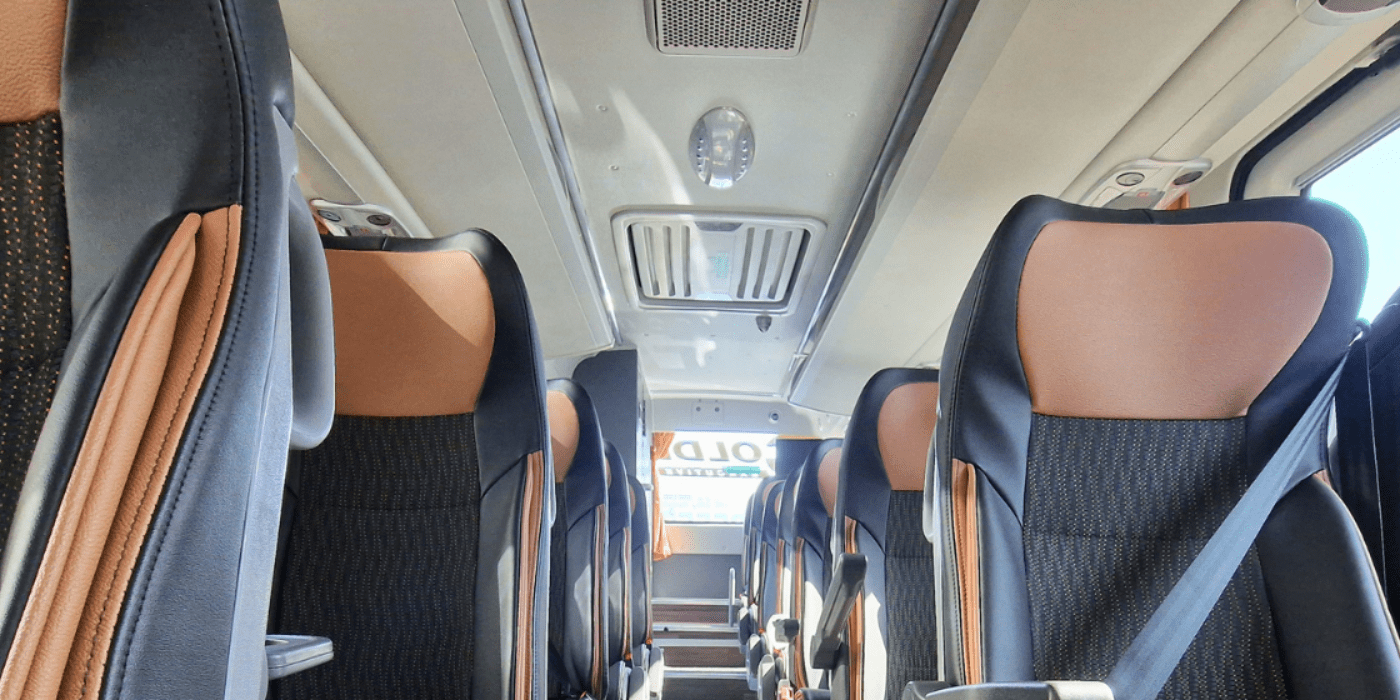
Group airport transfers: when a minibus beats three separate minicabs
Three separate minicabs sound like the obvious answer for a group of ten. They almost never are. Once you count the luggage, the arrival times and the real cost of three separate bookings instead of one, a single minibus wins for most groups above about six people, and this guide shows the actual arithmetic rather than a general “it depends.”
Key takeaways
- A standard minicab saloon realistically carries 1 to 4 passengers with 2 to 3 large cases. Push a fifth or sixth person and their luggage into that same booking and something gets left behind.
- Three separate minicab bookings for a 10 to 12 person group typically total somewhere in the £135 to £255 range for a single one-way airport run, once you add up three individual fares rather than one shared vehicle.
- Goldline’s minibus range runs 16 to 33 seats. A 16-seat minibus does not comfortably carry 16 people and 16 full-size cases at the same time; expect the realistic full-luggage capacity to sit closer to 10 to 12 passengers unless some seats are freed up for bags.
- A vehicle used commercially to carry 9 or more fare-paying passengers needs a driver with a PCV licence and an operator with a PSV operator’s licence, a different legal framework from the private hire licence that covers a standard minicab.
- Groups of 34 or more move into coach territory (43 to 70 seats), where a dedicated underfloor luggage hold means seats and bags stop competing with each other.
What counts as a group for an airport transfer?
There is no official cut-off, but in practice the decision point that matters is 5 passengers. Below that, a single minicab or MPV genuinely does the job. At 5 to 6, you’re at the edge of what one vehicle in Goldline’s minicab range (1 to 6 seat saloons and MPVs) can carry with full luggage. Above 6, you are choosing between multiple smaller vehicles and one larger one, and that choice is what this guide works through.
Group size on its own doesn’t tell the whole story, though. Two families of 4 flying on the same trip are a “group of 8” in one sense, but happy in two separate MPVs arriving minutes apart, unlike a work team of 8 who need to walk into check-in together. Luggage volume matters as much as headcount, and so does whether everyone genuinely needs to arrive at the same moment.
How many people and bags actually fit in a minicab, minibus and coach?
Here’s where most group travel guides stop at a seat count and call it done. Seats are only half the equation; luggage is the other half, and it’s where the nameplate numbers stop being useful.
| Vehicle | Passenger seats | Realistic luggage with full seats | What actually limits capacity |
|---|---|---|---|
| Standard saloon | 1 to 4 | 2 to 3 large cases plus hand luggage | Boot volume, roughly 450 to 500 litres, fills before the seats do |
| MPV | Up to 6 | 4 to 5 large cases plus hand luggage | Third-row seats compete directly with boot space |
| 16-seat minibus | 16 | Realistically 10 to 12 large cases if all seats are filled with passengers | No separate underfloor hold; luggage lives in the same cabin as the seats |
| 33-seat minibus | 33 | Similar trade-off, scaled up; expect a working capacity below the nameplate figure once full hold luggage is involved | Same cabin-sharing constraint as the 16-seater |
| Coach (43 to 70 seats) | 43 to 70 | One large case per passenger, plus hand luggage | Dedicated underfloor hold means bags never compete with seats |
The line that matters most in that table is the minibus row. A minibus body, whether it’s the 16-seat end of Goldline’s range or the 33-seat end, is built as one shared cabin, with no separate boot compartment underneath the floor the way a coach has. So when a group travel guide claims a 16-seat minibus carries “16 passengers and 16 suitcases,” treat that as an optimistic best case, not a working number. The rear luggage pen behind the last row typically holds somewhere in the region of 1.5 to 2.5 cubic metres, enough for roughly 10 to 15 cases stacked well, but that pen competes for space the moment every seat is also filled with a person. In practice, operators either run a 16-seat minibus at closer to 10 to 12 passengers with full hold luggage, or fill all 16 seats and ask passengers to travel with cabin bags only. Ask which configuration you’re getting when you book.
A coach doesn’t have this problem, and that’s exactly why the 34-plus bracket exists as its own category rather than “just a bigger minibus.” A dedicated underfloor hold on a 43 to 70 seat coach means the luggage bay and the passenger cabin are structurally separate, so a full coach can genuinely carry a case per passenger without anyone giving up legroom.
Is it cheaper to book one minibus than three separate minicabs?
For most groups above about 8 to 10 people, yes, once you count what three separate bookings actually cost rather than assuming a bigger vehicle must cost proportionally more.
Take a group of 12 needing three standard saloons, roughly 4 passengers each. A typical single-direction minicab fare for a mid-length London route sits somewhere in the £45 to £85 range depending on distance, time of day and vehicle size, the same range you’d see quoted for an individual East London to Heathrow run. Three of those bookings for the same trip come to somewhere between £135 and £255 in total.
That total isn’t three times the cost because the distance triples. It’s three times the cost because each separate minicab booking carries its own fixed overhead: a driver’s time, a separate trip minimum, separate fuel and insurance cost allocated to one small job instead of shared across twelve people. A single minibus covering the same group and distance runs that overhead once, not three times, which is the core reason group fares tend to undercut the sum of several individual ones past roughly 8 passengers. Divide £135 to £255 by 12 and you land around £11 to £21 a head just for three separate cars, before the coordination cost of managing three pickups. A fixed minibus quote, priced once for the whole group, is worth getting as a direct comparison; call 020 8555 5555 or use the Goldline app for a live quote against your specific group size and route.
What goes wrong when a group books three separate minicabs instead of one minibus
This is the part most group travel content skips entirely, and it’s where the real risk sits.
The group doesn’t arrive together. Three separate minicabs, even booked for the same time, rarely pull up within seconds of each other. Traffic and small gaps in departure time add up, and one car of the group ends up waiting outside the terminal, or walks in alone while the others are still minutes out.
Luggage gets split unevenly. Book three saloons without thinking it through and you can end up with five cases crammed into a car built for two or three, while another car has room to spare. Cases on laps or a case left behind because there wasn’t room both trace back to not matching luggage to vehicle capacity.
Risk multiplies with every extra booking. Any individual pickup carries some small chance of running late or hitting an unexpected delay. Book one vehicle and you’re exposed to that risk once. Book three for one group and you’re exposed to it three times over, and it only takes one to disrupt the whole group’s plans.
Nobody’s coordinating the group as a whole. Three bookings usually means three confirmation texts, three ETAs and three drivers’ numbers, often held by three different people. If a flight time changes, someone has to update three bookings rather than one, and that job falls through the gaps more often than it should.
Children and their car seats end up in different cars from the adult responsible for them. This happens when a family books piecemeal rather than as one party. A shared minibus, booked once with the full headcount and car seat needs stated up front, keeps every child with the adult watching them.
The cost stacks without anyone noticing. Three individually reasonable-looking fares add up to a total nobody compared against the group alternative, because nobody did the addition before booking. See the arithmetic above.
Which vehicle should your group book?
Group size and luggage together decide this, not headcount alone.
| Group size | Recommended vehicle | Why it works | Where it breaks down |
|---|---|---|---|
| 1 to 4, light to moderate luggage | Standard minicab saloon | Fastest, cheapest baseline for the trip | Any more than 4 people or 3 large cases and something won’t fit |
| 5 to 6, moderate luggage | MPV | One vehicle, one driver, boot handles 4 to 5 cases | 6 passengers each with a full-size hold case pushes past the boot’s real capacity |
| 7 to 15 | Two minicabs/MPVs travelling together, or one 16-seat minibus with room to spare | The genuinely awkward middle ground: too many for one MPV, often fewer than a minibus is really built for | Splitting a group of 7 or 8 across two vehicles reintroduces some of the same arrival-time and coordination problems as three separate minicabs, just with fewer cars |
| 16 to 33 | Minibus | One fare, one driver, whole group and their bags handled as a single trip | Below roughly 10 people, you’re paying for a lot of empty seats |
| 34-plus | Coach (43 to 70 seats) | Dedicated underfloor hold means full luggage without sacrificing seats | Overkill and expensive for anything under about 30 travelling together |
The 7 to 15 band deserves honesty rather than a tidy answer. No vehicle in most operators’ fleets, Goldline’s included, is sized precisely for 8 or 10 people with full luggage; minicabs top out at 6 seats and minibuses start at 16. For 8 to 10 with heavy luggage, running two MPVs together as one coordinated booking, same pickup window, often beats an under-filled 16-seat minibus on cost while keeping the group together. For 11 to 15, the minibus usually wins outright, since two MPVs at that headcount means splitting luggage-heavy passengers across cars anyway.
Do minibus drivers need a different licence to minicab drivers?
Yes, and this is a genuine legal distinction most group travel guides gloss over entirely. A standard minicab in London operates under a private hire licence, but a vehicle carrying 9 or more fare-paying passengers moves into a different regulatory category altogether. Under UK rules, a driver carrying passengers for hire or reward in a vehicle of that size needs a passenger-carrying vehicle (PCV) licence, and the operator running the service needs a public service vehicle (PSV) operator’s licence, distinct from private hire licensing entirely.
This matters practically, not just legally. It means an unlicensed people-carrier arranged informally through a group chat, however well-meaning, is operating outside the rules the moment money changes hands for a 9-plus seat vehicle. A properly licensed minibus operator carries the PCV-qualified driver and the operator’s licence the informal alternative doesn’t, worth checking before you hand over a deposit for a large group.
Government guidance on driving a minibus defines it as a vehicle with up to 16 passenger seats, which is why Goldline’s minibus range starts at that figure and extends to 33-seat vehicles for larger parties, before stepping up into coach territory for anything bigger still.
Are minibus seat belts and child seats different from a minicab’s?
The belt requirements scale with vehicle age and size rather than being identical across every vehicle type, which matters if your group includes children. For minibuses carrying 8 to 16 seated passengers, vehicles first used from 1 October 2001 onward require inertia-reel three-point belts in every forward-facing seat, front and rear alike. Where a group is travelling with 3 or more children on an organised trip, government guidance on seat belts in minibuses, coaches and other buses requires a forward-facing seat with at least a lap belt for each child, regardless of how old the vehicle itself is.
Practically, that means a licensed operator’s minibus fleet is built around these standards as a baseline, not an optional extra, which isn’t something you can take for granted with an informally arranged vehicle. If your group includes young children needing car seats specifically, rather than just a seat belt, say so when you book; car seats need to be fitted to the specific seating position, and it’s a request worth making in advance rather than assuming any vehicle can accommodate it on the day.
A family of 7 flying from Heathrow: which vehicle actually works?
Two parents, a grandparent and 4 children, flying long-haul from Heathrow, with a case each, a travel cot and two car seats needed for the youngest two. Seven people already rules out a single minicab or MPV outright, since Goldline’s minicab range tops out at 6 seats.
The realistic choice is between two MPVs, split roughly 4 and 3, or one 16-seat minibus. Two MPVs at £70 to £85 each for a mid-length Heathrow run comes to £140 to £170 total, and it works, but the youngest children and their car seats have to be correctly split across two vehicles, with someone responsible for the right seat ending up in the right car. One minibus keeps the whole family, both car seats and the travel cot, together in a single booking with a single pickup time. For a family this size, the coordination saved by not splitting young children across two vehicles is often worth more than the modest cost difference; the Heathrow airport transfer page covers what to expect from a Heathrow pickup in more detail.
A 12-person work trip to the airport: minibus or convoy of minicabs?
A team of 12 heading to a conference, mostly cabin bags and laptop cases rather than hold luggage, with a shared flight and a genuine need to walk into the terminal together rather than trickle in over twenty minutes. Three standard saloons at roughly £50 to £70 each for a Gatwick-length run total somewhere around £150 to £210, and that’s before accounting for the fact that three cars leaving the office at the same moment rarely arrive within the same five minutes of each other.
One minibus solves the arrival-time problem outright: the whole team leaves together, arrives together, and walks into check-in as a group rather than as three staggered arrivals, which matters more than it sounds for a client-facing trip, and it removes the admin of three confirmation texts landing on three phones. This is one of the clearest cases where a single vehicle beats splitting the group, even before the cost comparison. The Gatwick airport transfer page has more detail on booking for business travel.
A wedding party travelling to Gatwick: how many vehicles do you need?
A bridal party and family flying out together for a destination wedding, somewhere between 16 and 20 people once everyone’s confirmed, and heavy on luggage: dress bags, suit carriers, gifts, and the kind of cases nobody wants squeezed. A wedding party is exactly the case where arriving separately genuinely damages the day rather than being a minor inconvenience; if the group needs to check in together, or simply wants the whole party arriving as one, staggered minicabs undermine that from the start.
At 16 people with heavy luggage, one 16-seat minibus is workable if some seats are freed up for the extra bag volume; at 20, the group needs either a slightly larger minibus from the 16 to 33 range or a minibus plus one additional minicab for the overflow, worked out at booking rather than guessed on the day. Either way, this is a job for Goldline’s minibus range rather than a chain of separate cars, and worth booking well ahead given how far in advance wedding travel is usually planned.
A group of 5 with hand luggage only to Stansted: do they need a minibus?
Not every group needs one, and this scenario shows why. Five friends heading to Stansted for a weekend away, all travelling with cabin bags only, no hold luggage at all. This sits right at the edge of what a single MPV comfortably carries, and with no heavy luggage to worry about, one vehicle does the whole job. Booking a minibus here would mean paying for eleven empty seats and gaining nothing in return; a single MPV, or a saloon plus one extra passenger seat depending on exact vehicle availability, is the sensible call. It’s a useful reminder that group size on its own doesn’t automatically mean “book bigger”; luggage volume and how many people you actually have decide it together.
Who a group minibus booking isn’t for
Groups genuinely splitting to different final destinations. If half a wedding party is heading to a hotel and the other half somewhere else entirely, a shared minibus doesn’t solve anything; book separate minicabs matched to each destination instead.
Small groups with light luggage. Under about 5 people with hand luggage only, a minicab or MPV is cheaper, simpler, and arrives just as fast. A minibus for a group this size is paying for space nobody uses.
Groups arriving on genuinely different flights, hours apart. Waiting for the last passenger to clear customs before a shared vehicle can leave holds up everyone who landed earlier. If your group’s flights are staggered by more than an hour or two, separate meet-and-greet minicabs timed to each flight usually work better, even if the total cost ends up higher than one shared minibus would have been.
Groups who each want to pay their own way rather than split a single fare. A shared minibus fare needs one person, or an agreed method, to handle payment and splitting afterward. If your group is really several separate parties who each want their own receipt and their own booking, separate minicabs, even with the coordination drawbacks covered above, may suit the group’s actual preference better than a shared vehicle would.
Minibus vs coach vs multiple minicabs vs Uber XL: which wins for your group?
Each of these genuinely wins in a specific situation, and being honest about where Goldline’s own minibus and coach range loses is part of giving useful advice.
Ride-hail XL services (Uber XL, Bolt XL) cover a 6-seat gap reasonably well for a spontaneous, light-luggage trip, but pricing moves with demand, there’s no dedicated group tier beyond about 6 seats, and you’re relying on whichever driver the app assigns rather than a vetted operator.
Scheduled coach services, run by operators such as National Express on fixed routes and timetables, are genuinely the cheapest per head for a group willing to work around a set departure time and pickup point rather than door-to-door collection. They don’t help if your group needs collecting from several addresses.
Rail (the Elizabeth line for Heathrow, Gatwick Express or Southern for Gatwick, the Stansted Express) is fast and cheap for a group travelling light, but breaks down once luggage or children are involved; a group of 5 or more with hold cases and a change of train is a worse experience than one shared vehicle, and it doesn’t do door-to-door.
Self-driving in a convoy of personal cars costs nothing extra for the vehicles, but nobody relaxes, parking adds its own charge on top of fuel, and coordinating several separately-driven cars carries most of the same arrival-time problems as three separate minicab bookings.
A licensed minibus or coach, matched to group size using the table above, wins specifically when the group needs to travel and arrive together, has luggage that needs handling as one job rather than several, and would rather pay one fixed, agreed price than assemble several separate bookings and hope they align on the day.
How early should a group book an airport minibus?
Book a group vehicle as soon as travel dates are confirmed, ideally several weeks ahead for anything above 10 people, and earlier still around weekends, half-term and the Christmas travel period when minibus and coach availability tightens fastest. A single minicab can often be booked the same day with reasonable confidence of availability; a 16 to 33 seat minibus, especially for a specific date like a wedding or a conference, is a different kind of booking, and leaving it to the last minute risks the exact vehicle size your group needs simply not being available at short notice. Goldline takes bookings by phone, app, website or WhatsApp, 24 hours a day, 365 days a year, so there’s no reason to delay confirming a group booking once the date and headcount are known, even if the exact final passenger count is still being confirmed.
Mistakes people make booking group airport transfers
- Assuming a bigger vehicle costs proportionally more. A single minibus often undercuts the sum of several separate minicab fares once each booking’s individual overhead is counted, not just distance.
- Not stating the exact luggage count at booking. A group of 10 with 10 full-size cases needs a different vehicle configuration than the same 10 people with cabin bags only; say which applies before the day, not on the forecourt.
- Booking piecemeal, with different members of the group each arranging their own car. This is how a group ends up with three overlapping, uncoordinated bookings instead of one, and it’s the biggest cause of the arrival-time and luggage problems above.
- Leaving a large group booking until the last few days before travel. Minibus and coach availability for a specific date is finite in a way a single minicab usually isn’t.
- Forgetting car seats or wheelchair access needs until the day of travel. Both are available on request, but need stating at booking so the right vehicle is allocated in advance.
- Ignoring the licensing question when arranging an informal minibus. A vehicle carrying 9 or more fare-paying passengers needs a PCV-licensed driver and a PSV operator’s licence behind it; an informal people-carrier for cash may have neither.
Is a minibus worth it for your group? Our verdict
Our view: for any group of 8 or more travelling to the same flight with meaningful luggage, book one minibus rather than splitting across separate minicabs. The arithmetic favours it past roughly that point, the arrival-time and luggage problems that come with multiple separate bookings largely disappear, and it’s one booking to manage instead of several. For groups of 7 to 15, get an exact quote for both a coordinated two-vehicle booking and a single minibus before deciding; which wins depends on your specific luggage volume and the fares on the day, and it’s genuinely close enough that it’s worth asking rather than guessing. Below 5 people with light luggage, don’t overspec; a minicab or MPV does the job for less, and a minibus for a group that size is paying for space nobody needs.
Group airport transfer FAQ
Q1 What’s the minimum group size that makes a minibus worth booking?
There’s no fixed rule, but the arithmetic in this guide generally favours a minibus from around 8 passengers with meaningful luggage. Below that, a minicab or MPV usually works out cheaper and simpler.
Q2 Can Goldline provide car seats for a group minibus booking?
Yes, but request them at the time of booking rather than assuming they’ll be available on the day, since the right seat needs to be fitted to a specific position in the vehicle.
Q3 Do I need to give an exact final headcount when I book a group minibus?
A rough headcount at booking is enough to reserve the right vehicle size, but confirm the exact final number as close to travel as possible, since it affects both the vehicle chosen and how luggage is configured inside it.
Q4 Is a minibus safe for children compared to a standard minicab?
Minibuses carrying 8 to 16 seated passengers, built from 1 October 2001 onward, require inertia-reel three-point belts in every forward-facing seat. Where 3 or more children are travelling on an organised trip, a forward-facing seat with at least a lap belt must be provided for each child, regardless of the vehicle’s age.
Q5 What happens if some of my group are on a different flight to the rest?
If flights land more than an hour or two apart, a single shared vehicle waiting for the last arrival holds everyone else up. Separate meet-and-greet minicabs timed to each flight usually work better in that situation, even though it costs more overall than one shared booking.
Q6 Does a minibus still offer meet-and-greet at the airport?
Yes, meet-and-greet is available as an add-on for minibus bookings the same way it is for a standard minicab, along with flight monitoring so the pickup adjusts if the group’s flight lands early or late.
Q7 How much luggage can a 16-seat minibus actually carry?
Realistically, somewhere in the range of 10 to 12 full-size cases if all 16 seats are also filled with passengers, since the luggage area and the passenger cabin share the same space on a minibus. For a group needing full luggage and every seat filled, check the exact configuration when booking rather than assuming both maximums apply at once.
Q8 Is it legal for any large van or people-carrier to be booked as a paid group transfer?
Not for 9 or more fare-paying passengers. That size of vehicle needs a driver with a PCV licence and an operator holding a PSV operator’s licence, separate from standard private hire licensing, which an informally arranged vehicle may not have.
Q9 What’s the difference between a minibus and a coach for an airport transfer?
Broadly, seat count and how luggage is stored. Goldline’s minibus range covers 16 to 33 seats with luggage sharing the passenger cabin; coaches cover 43 to 70 seats with a dedicated underfloor hold, so luggage and seating don’t compete with each other.
Q10 Can a wheelchair user travel as part of a group minibus booking?
Yes, request a wheelchair-accessible vehicle as part of the group booking in advance so the right vehicle is allocated alongside the rest of the group’s transport, rather than arranged separately on the day.
Q11 Is booking three separate minicabs ever the right call for a group?
Occasionally, mainly when the group is genuinely heading to different final destinations, or arriving on flights hours apart, where a shared vehicle wouldn’t actually solve anything. For a group travelling to and from the same place at the same time, one coordinated vehicle almost always beats three separate bookings.
Q12 How far in advance should I book a minibus for a wedding party or large event?
As early as the date and rough headcount are confirmed, and certainly several weeks ahead where possible. Minibus and coach availability for a specific date is more limited than a same-day minicab booking, especially around weekends and peak travel periods.
Three things only Goldline can answer
This guide is built from published vehicle specifications, government licensing and safety rules, and derived arithmetic on cost and luggage capacity; no first-hand Goldline booking data was available to draw on for this article. Three things worth asking directly when you call, because no outside guide, including this one, can answer them as well as Goldline’s own dispatch team:
- The exact live fixed quote for your group’s specific size, luggage volume and route, rather than the estimated ranges used throughout this guide.
- Real-time availability of the right vehicle size for your travel date, particularly for a 16-seat-plus minibus or a coach booked close to a weekend or peak period.
- Which specific vehicle from the fleet, minibus, coach, or a coordinated pair of MPVs, is the right match for your group on the day, based on final headcount and luggage once it’s confirmed.
Call 020 8555 5555
Full detail on airport-specific pickup arrangements sits on the airport transfers hub page, covering Heathrow, Gatwick, Stansted, Luton and London City.