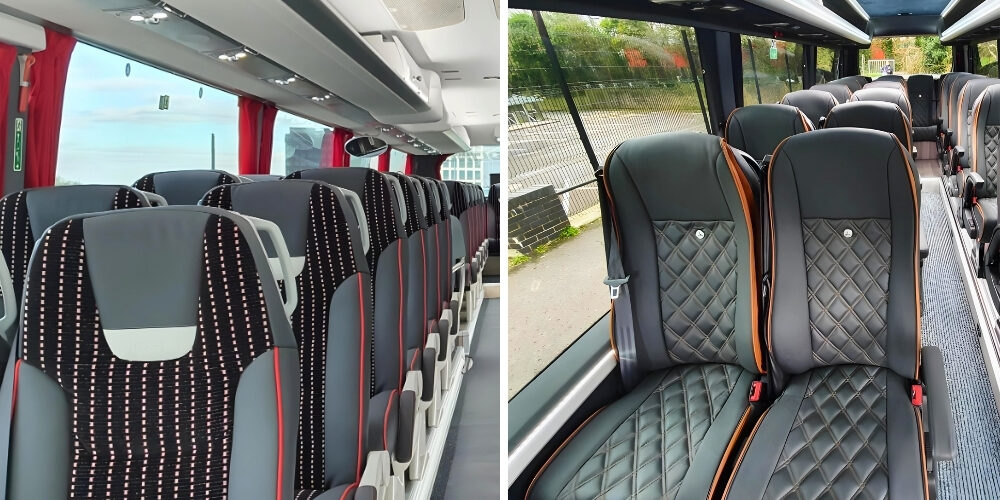
For groups of 8 to 22 people, an executive minibus is usually the right vehicle. Once a group passes roughly 22 to 24 people, a coach becomes the more practical and often cheaper-per-head option, with Goldline coach options running from 22 seats up to 72 seats. The right choice depends on more than headcount alone. Luggage, pickup location, and where the vehicle needs to park in London all change the answer.
Key takeaways:
- Goldline’s fleet includes 8 seat vehicles, 16 to 19 seat minibuses, and coaches ranging from 22 to 72 seats
- A fully loaded 16 to 19 seat minibus with luggage typically has space for 12 to 16 full suitcases, not 16 to 19
- A large 72-seat coach may not be suitable for every central London venue because of access, parking and turning restrictions
- Booking a vehicle sized to your exact headcount, with no spare capacity, is one of the most common and costly group travel mistakes
- Splitting a group of 30 into two minibuses instead of one 33-seat coach typically costs 20 to 30% more per person
What Counts as a Minibus vs a Coach in the UK?
There’s a genuine legal line here, not just an industry convention. Category D1 covers minibuses with 9 to 16 passenger seats, and any vehicle with more than 8 passenger seats sits outside standard car licensing entirely. In practice, the trade uses “minibus” more loosely than the licence categories do. Goldline’s own fleet runs an 8-seat executive vehicle as the smallest option, then 16 to 19 seat and 22-seat minibuses, before stepping up into coach-classed vehicles at 33 seats and above. A coach is built for longer journeys and larger groups: underfloor luggage holds, higher seating, and on larger models, onboard toilets and fold-out tables that a minibus simply doesn’t have room for.
Minibus or Coach: The Suitability Matrix
This table gives a practical starting point, because passenger numbers are only one part of the decision.
| Group size | Recommended vehicle | Why it works | Consider a larger vehicle when | Useful Goldline page |
|---|---|---|---|---|
| 1 to 7 | Executive car or transporter | A minibus may be oversized for a small group. | Passengers have several large suitcases or specialist equipment. | View transporters |
| 8 | 8 seat vehicle | A suitable fit for a small group with light luggage. | Each passenger is carrying a large suitcase. | View minibuses |
| 9 to 16 | 16 seat standard or executive minibus | A practical balance of comfort, manoeuvrability and cost. | The group is close to capacity and carrying heavy luggage. | View 16 seat options |
| 17 to 19 | 19 seat minibus | Keeps a medium sized group together while remaining suitable for many London streets. | The journey is long or the group has substantial luggage. | View the minibus fleet |
| 20 to 22 | 22 seat coach | Provides dedicated luggage capacity and coach style seating. | Extra luggage space, onboard facilities or spare seats are required. | View coaches |
| 23 to 33 | 33 seat coach | One vehicle is normally simpler and more economical than two minibuses. | The confirmed passenger count may increase. | View 33 seat coaches |
| 34 to 49 | 49 seat coach | A standard large coach choice for events, schools and corporate groups. | The group includes staff, organisers or extra passengers not included in the initial count. | View 49 seat coaches |
| 50 to 57 | 57 seat coach | Suitable for larger school, event and tour groups. | More passengers are expected or additional space is needed. | View larger coaches |
| 58 to 72 | 72 seat coach | Keeps a large group together in one vehicle. | The venue has access restrictions or the route is unsuitable for a large coach. | View the coach fleet |
Minibus Sizes Explained: What 8, 16 to 19 and 22 Seats Actually Means for Luggage
Seat count and luggage capacity are two separate numbers, and this is where most bookings go wrong. Doing the arithmetic on Goldline’s 16 to 19 seat executive minibus: fully seated with 16 passengers, realistic luggage space sits around 12 to 16 standard suitcases when bags are loaded carefully, not a full case per person if the group is at maximum capacity and everyone has a large case. For an airport transfer with a full complement of 16 passengers and holiday luggage, that’s tight enough that we’d recommend the 22-seat minibus instead, booked for 16 people, purely for the extra hold space. The same logic applies to group travel at every size: a vehicle rated for a headcount is not automatically rated for that headcount’s luggage.
For the 8-seat executive vehicle, expect comfortable space for 6 to 8 full suitcases. Again, book for 6 passengers if everyone is bringing a large case and you want genuine comfort rather than a squeeze.
How Much Does It Cost to Split a Group Across Two Minibuses vs One Coach?
This is one of the most common questions we get, and the arithmetic is worth doing properly rather than guessing. Take a group of 30 people.
- Option A: two 16-seat minibuses. Two separate bookings, two drivers, two vehicles running the same route. Splitting a group this way typically costs 20 to 30% more per person than a single larger vehicle, because you’re paying for two driver shifts, two sets of fuel, and two vehicles’ worth of Congestion Charge and parking rather than one.
- Option B: one 33-seat coach. A single booking, single driver, single vehicle, with two empty seats to spare for genuine comfort and luggage overflow. This is very close to always the cheaper and simpler option once the group passes roughly 24 to 26 people.
- The scenario where splitting still makes sense: if your group needs to depart from two different pickup points that are a significant distance apart, say, one half of a wedding party gathering in East London and the other in a completely different part of the city, two smaller vehicles running independent routes before converging can still be the more practical choice, even at a higher combined cost, because it saves the time of one vehicle doing two separate collection loops.
Minibus and Coach Hire in Central London: The Access Problem Nobody Mentions
This is the gap most seat-count guides skip entirely, and it matters more in London than almost anywhere else in the UK. A 72-seat coach may be the correct size on paper for a large group, but central London imposes physical constraints that headcount alone does not account for:
- Height restrictions. Some central London routes and venue approaches have height, width or access restrictions. Always confirm venue access before booking the largest vehicle in the fleet.
- Turning circles. Narrow streets around historic venues, many wedding venues, and older hotels were never built with a 12-metre coach in mind. A 33 or 49-seat coach may be able to access routes that are unsuitable for a larger 72-seat coach.
- Coach parking bays. Central London has a limited number of designated coach parking and set-down bays, and popular ones fill up on event days. Booking with a company that plans the drop-off and collection point in advance, rather than assuming the vehicle can simply pull up outside, avoids a genuinely common last-minute problem.
- Congestion Charge and ULEZ. These apply per vehicle per day regardless of size, so one larger coach also means one Congestion Charge payment rather than two, another point in favour of consolidating into a single vehicle where venue access allows it.
Because every Goldline pickup runs from London outward, we plan routing and drop-off points around these restrictions as standard, rather than discovering them on the day.
Who This Isn’t For
A coach isn’t the right call for every group that happens to be over 20 people. If your group is 20 people making several short stops across a single evening, a progressive dinner, a multi-venue stag do, a wedding shuttle running back and forth between a hotel and a venue, a 22-seat minibus that can navigate tighter streets and stop more freely will usually serve you better than a coach that’s harder to manoeuvre and slower to load and unload repeatedly. And if your group is under 12 and travelling a short distance, don’t book a 33-seat coach “to be safe”: you’ll pay coach rates to move minibus numbers, and the vehicle will feel and look half-empty, which is a worse experience for guests at something like a wedding than a right-sized minibus.
Real-World Scenarios: Choosing the Right Size
- A corporate offsite for 19 people, one pickup point, one destination two hours away. The 22-seat executive minibus is the right call here. It gives enough room for comfort and full luggage, still nimble enough for tighter access roads at a countryside venue, and meaningfully cheaper than stepping up to a coach for 3 spare seats you don’t need.
- A school trip of 45 pupils plus 4 staff to a single destination. The 49-seat coach is the clean answer: one vehicle, one driver, straightforward headcount, and proper luggage hold space for the day’s equipment and bags.
- A wedding with 60 guests needing transport between a countryside ceremony and a London reception. The 72-seat coach covers the full guest list in a single vehicle, avoiding the coordination headache and cost premium of splitting the party, and gives comfortable spare capacity for the bridal party’s additional bags and dress considerations.
- A stadium event for 70 fans travelling together from a single East London pickup point. A 72-seat coach can keep the group together, provided the stadium’s coach drop-off point and access arrangements are confirmed in advance.
- A hen party of 14 with heavy luggage for a weekend away. On paper, this fits a 16-seat minibus. In practice, book the 22-seat minibus instead. The extra hold space for weekend bags, plus a change of outfit for the evening, is worth the small cost step-up, and it avoids arriving to find cases stacked on laps.
Mistakes People Make Choosing Between Minibus and Coach
- Booking to the exact headcount with no spare capacity. If your group is 16, a 16-seat minibus leaves zero room for a last-minute plus-one, a staff member, or simply breathing space with luggage. Book slightly above your confirmed number where the budget allows.
- Ignoring luggage until the day of travel. The single biggest cause of on-the-day problems. Always tell your operator the realistic luggage load, not just the passenger count, at the time of booking.
- Assuming bigger is always cheaper per head. True from roughly 24 seats upward, but not below it. A half-full 33-seat coach for a group of 15 costs considerably more per person than a right-sized 16-seat minibus.
- Not checking venue access for larger vehicles. Double-decker coaches and even standard 49 or 72-seat coaches can be physically unable to reach some central London and countryside venues. Confirm access before locking in vehicle size, not after.
- Splitting a group across two minibuses purely out of habit. Once a group passes roughly 24 to 26 people, a single coach is very likely both cheaper and simpler than two minibuses, even if “two minibuses” was the first instinct.
Minibus vs Coach: What People Get Wrong
The most persistent myth is that minibus and coach are interchangeable terms for “a bus that isn’t a car.” They’re licensed, built, and priced differently, and the practical cutoff in London specifically isn’t just about headcount. It’s about where the vehicle can physically go. A second myth: that hiring the largest vehicle available is always the safest choice for a big group. In central London, it can be the opposite: an oversized vehicle that can’t reach the venue creates more disruption than a correctly sized one that can.
Which Vehicle Should You Choose? Our Verdict
For most groups, the honest advice is to book one size above your confirmed headcount rather than exactly to it, and to always declare luggage at the time of booking rather than assuming it will “just fit.” For London specifically, confirm venue access for anything above a 49-seat coach before the booking is locked in. It’s the single most avoidable disruption in group travel, and it costs nothing to check in advance.
Minibus vs Coach Hire: FAQ
Q: How many seats does a minibus have in the UK?
A: Executive minibuses in Goldline’s fleet run from 8 seats up to 22 seats. Above that, vehicles are classed as coaches, starting at 33 seats.
Q: How many seats does a coach have?
A: Goldline’s coach fleet includes options from 22 seats up to 72 seats, including 33, 49, 57 and 72-seat vehicles.
Q: What size minibus do I need for 15 people?
A: A 16 to 19 seat executive minibus fits 15 people comfortably with room for light to moderate luggage. For full suitcases at that headcount, consider stepping up to a 22-seat minibus.
Q: Is it cheaper to hire two minibuses or one coach for 30 people?
A: One coach is almost always cheaper per person for a group of this size, typically by 20 to 30%, because you’re paying for one driver and one vehicle instead of two of each.
Q: Can a large coach access every central London venue?
A: Not always. Narrow streets, access restrictions and limited coach parking mean some venues cannot accommodate a 72-seat coach. Always confirm access before booking.
Q: How much luggage fits in a 16-seat minibus?
A: Realistically 12 to 16 standard suitcases when the vehicle is fully seated, depending on case size. For a full complement of 16 passengers each bringing a large case, a 22-seat minibus offers more comfortable hold space.
Q: Do coaches have toilets?
A: On selected vehicles, yes, typically the larger coaches in the fleet. Confirm this at the time of booking if it’s important for your journey length.
Q: What’s the minimum group size for coach hire to make sense?
A: Around 24 to 26 people is usually the point where a coach becomes cheaper and more practical than splitting the group across multiple minibuses
Q: Can I book a smaller vehicle than my exact headcount to save money?
A:We’d advise against it. Booking to the exact number leaves no room for luggage, latecomers, or genuine comfort, and the saving is usually small compared to the disruption it risks.